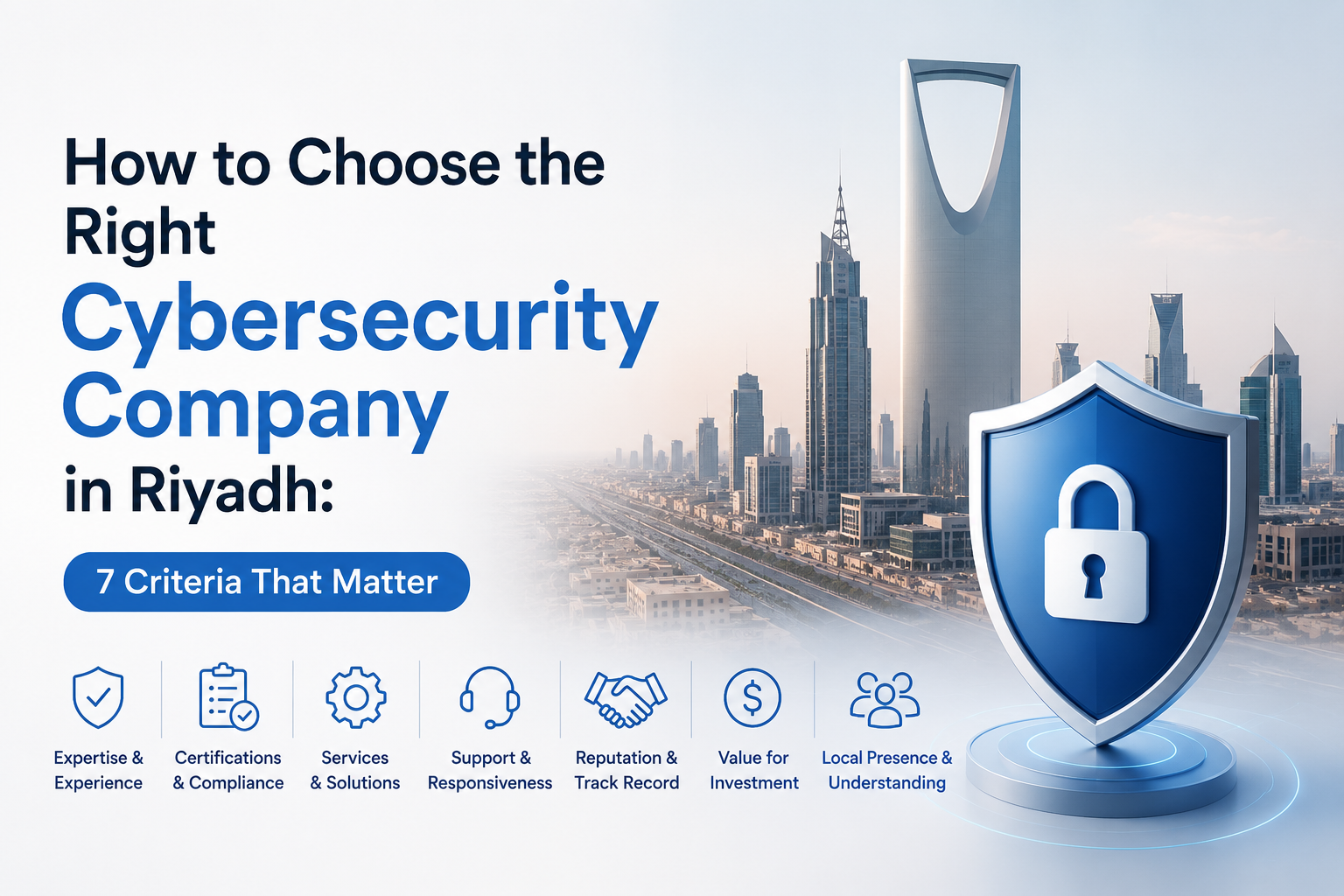


Saudi Arabia’s business sector is experiencing rapid digital transformation under Vision 2030, creating major economic opportunities while also increasing cybersecurity risks. Businesses face advanced threats such as AI-powered phishing, ransomware attacks, supply chain breaches, credential theft, and cloud security misconfigurations
Saudi Arabia's digital transformation is creating enormous economic opportunity — and attracting sophisticated cybercriminals who see that opportunity too. As Vision 2030 accelerates the Kingdom's digitalization, the attack surface available to threat actors expands in parallel. Organizations in Riyadh, Jeddah, and across the Kingdom are facing threats that are more targeted, more sophisticated, and more consequential than anything seen in previous years.
Understanding the threat landscape is the first step in building adequate defenses. Here are the top cybersecurity threats Saudi businesses face in 2026, with practical guidance on what organizations can do about each one.
1. AI-Powered Phishing and Social Engineering
The phishing attacks targeting Saudi organizations in 2026 bear little resemblance to the obviously suspicious emails of five years ago. Attackers now use generative AI to craft perfectly written Arabic-language phishing emails, WhatsApp messages impersonating government agencies, and voice-cloned phone calls that sound exactly like colleagues or senior managers. The quality of deception has improved dramatically.
What this means: purely technical email filtering is no longer sufficient. Organizations need continuous phishing simulation programs, strong incident reporting culture, and multi-factor authentication that renders compromised credentials less useful even when phishing succeeds.
2. Ransomware Targeting Critical Infrastructure
Ransomware groups have identified Saudi Arabia's energy, utilities, healthcare, and manufacturing sectors as high-value targets. Attacks in 2024 and 2025 have demonstrated both the technical sophistication of these groups and their willingness to disrupt critical services to maximize ransom leverage. Several significant Saudi organizations have faced operational disruption from ransomware incidents affecting both IT and OT systems.
Effective defense requires network segmentation, comprehensive backup management with tested recovery procedures, EDR deployment on all endpoints, and documented incident response plans that the organization has actually rehearsed.
3. Supply Chain Attacks
Saudi enterprises increasingly rely on an ecosystem of software vendors, IT service providers, and technology suppliers. Attackers who compromise a supplier can use that access to reach dozens or hundreds of the supplier's Saudi customers simultaneously. The SolarWinds and MOVEit attacks demonstrated how devastating well-executed supply chain compromises can be.
Organizations need formal third-party cybersecurity risk assessment programs — a requirement under both NCA ECC and SAMA CSF — that evaluate the security posture of critical suppliers before and during the relationship.
Read: Cyber Security in UAE: Why Businesses Need It in 2026
4. Credential Stuffing and Account Takeover
Billions of stolen username and password combinations from global data breaches are available to attackers. Saudi employees who reuse passwords across work and personal accounts are routinely targeted through automated credential stuffing attacks that try known compromised credentials against corporate systems. The success rate is higher than most IT teams realize.
MFA implementation across all critical systems — particularly email, VPN, and administrative access — is the single most effective control against this threat category.
5. Insider Threats — Malicious and Negligent
Insider incidents remain underreported and underappreciated as a threat category in Saudi organizations. They range from genuinely malicious insiders deliberately exfiltrating data or sabotaging systems, to negligent employees who inadvertently cause breaches through poor security practices. Both are real and both require controls that most organizations have not fully implemented.
Privileged access management, user behavior analytics, DLP controls, and robust offboarding procedures address different dimensions of insider risk and together create meaningful deterrence and detection capability.
6. Cloud Misconfiguration
As Saudi organizations migrate workloads to AWS, Azure, and Oracle Cloud, the cloud misconfiguration problem is growing rapidly. Exposed storage buckets, over-privileged service accounts, unencrypted databases, and publicly accessible management ports are common findings in cloud security assessments across Saudi enterprises. Unlike traditional data center security failures, cloud misconfigurations can expose data to the entire internet within minutes of deployment.
Cloud security posture management (CSPM) tools and dedicated cloud security expertise are essential for organizations managing significant cloud workloads.
Conclusion
The Saudi cybersecurity threat landscape in 2026 is more complex and more dangerous than at any previous point. Organizations that wait for an incident before investing in security consistently pay far more — in breach costs, regulatory consequences, and reputational damage — than those who build proactive defenses. Understanding the specific threats you face is the essential starting point.
Frequently Asked Questions
Q: What is the most common cyberattack in Saudi Arabia?
A: Social engineering attacks — particularly phishing via email, SMS, and WhatsApp — remain the most common initial attack vector in Saudi Arabia. AI-generated Arabic-language phishing content has significantly improved the quality of these attacks in 2025.
Q: Are Saudi SMEs targeted by cybercriminals?
A: Yes. Small and medium enterprises are frequently targeted precisely because they typically have weaker security controls than large organizations. Automated attack tools do not discriminate by company size. Saudi SMEs in supply chains of large enterprises are particularly targeted as a route to larger victims.
Q: How does Vision 2030 affect Saudi cybersecurity risks?
A: Vision 2030's digital transformation agenda is dramatically expanding Saudi Arabia's digital attack surface. More digital services, more cloud adoption, more IoT connectivity, and more critical national functions moving online all create more targets for cybercriminals and nation-state threat actors.